
What Is Solarpunk? (A practical guide to solarpunk living and 7 ways to start today)
Updated: Oct 8
What is Solarpunk?
Solarpunk is a creative movement and way of imagining a future where people, technology, and nature can live in harmony and thrive together. Instead of accepting a future defined by extraction, waste, isolation, and climate anxiety, it asks what we could grow, restore, repair, redesign, and share.
Solarpunk is one of those ideas that clicked for me almost immediately.
So much of the conversation around sustainability focuses on everything that is going wrong and understandably so. Climate change, biodiversity loss, pollution, waste, food insecurity, and growing inequality are real problems that deserve serious attention.
But knowing what we don’t want isn’t quite the same as knowing what we’re trying to build.
That’s where Solarpunk comes in.
Maybe you’ve seen the aesthetic before: lush cities covered in plants, solar panels tucked between colorful buildings, community gardens, bicycles, handmade clothing, and neighborhoods that look like nature was invited back in.
I love that imagery, too.
But the more I’ve learned about Solarpunk, and the more I’ve worked with gardens, food systems, biodiversity, and regenerative practice, the more interested I’ve become in what exists underneath the aesthetic.
Because Solarpunk isn’t really about covering skyscrapers in plants.
It’s about asking a much more interesting question:
What would our communities look like if we designed them to give something back to people, to nature, and to the generations that come after us?
And then comes the part I care about most:
How much of that future can we start building right now? In one sentence:
Solarpunk is grounded optimism made visible, imagining regenerative futures, then practicing pieces of them in the present.
Ready to begin with one small action?
Join The Eco Connection’s free 7-Day Solarpunk Living Reset
What does Solarpunk mean?
Solarpunk is a movement that stretches across speculative fiction, art, design, architecture, fashion, activism, sustainability, and everyday life.
At its core, it explores what a more ecological, equitable, and life-giving civilization could look like, and how we might begin moving toward it.
The word itself combines solar, representing renewable energy, sunlight, and possibility, with punk, representing a willingness to question systems that feel harmful, extractive, unjust, or inevitable.
There isn’t one official Solarpunk rulebook and personally, I think that’s part of what makes the idea so useful.
It gives us room to ask what a regenerative future could look like in different communities, climates, cultures, and ecosystems.
Solarpunk might appear in a novel or an illustration. But it could just as easily show up as:
a neighborhood growing food, a library lending tools, a building designed for shade and airflow, a seed exchange, a repair café, a community-owned renewable energy project, or a balcony filled with herbs and pollinator plants.
What connects these things isn’t a particular shade of green or a futuristic skyline.
It’s the belief that a better future should be practical, beautiful, inclusive, regenerative, and worth participating in.
Where did Solarpunk come from?
Solarpunk is still a relatively young term, but the ideas behind it are much older.
The word began circulating online around 2008, when an early blog post inspired by a cargo ship using a large kite sail imagined a new speculative genre centered around sustainability and renewable technology.
The idea continued to grow.
An early Solarpunk anthology published in Brazil brought ecological speculative fiction together under the Solarpunk name, and in 2014 futurist Adam Flynn’s essay Solarpunk: Notes toward a manifesto helped give the movement a clearer vocabulary around ingenuity, decentralization, creative reuse, resilience, and optimistic problem-solving.
Since then, Solarpunk has continued to evolve through artists, writers, gardeners, architects, designers, organizers, researchers, and online communities.
But it didn’t appear out of nowhere.
Many of the ideas associated with Solarpunk overlap with much older practices and movements, including:
agroecology
permaculture
ecological restoration
appropriate technology
green urbanism
circular economies
environmental justice
community resilience
local food systems
mutual aid
Indigenous sovereignty
place-based ecological knowledge
That history matters.
Because Solarpunk shouldn’t be reduced to an AI-generated city covered in vines.
It is part of a much larger conversation about who gets to shape the future, whose knowledge matters, what we consider progress, and how human systems relate to the living world around them.
What makes Solarpunk “punk”?
The punk part isn’t there just because it sounds interesting.
It points to a refusal to accept that an extractive, disposable, overconsumption-based, disconnected future is our only realistic option.
Solarpunk questions systems where resources are endlessly extracted, products are designed to be replaced, ecosystems are treated as expendable, and communities have very little control over the systems shaping their lives. But one of the things I find most compelling about Solarpunk is that its resistance is usually constructive.
It doesn’t stop at: This isn’t working.
It asks: What could we build instead?
That might look like people sharing tools instead of everyone buying the same thing.
Repairing an appliance instead of immediately replacing it.
Protecting public green space.
Restoring native habitat.
Growing more food locally.
Designing buildings around the local climate.
Creating stronger neighborhood networks.
Or developing technologies that solve real problems without creating entirely new ones.
The rebellion isn’t only in what Solarpunk rejects. It’s in what people choose to build together.

Solarpunk isn’t optimism that ignores difficulty. It’s optimism that accepts the work and still believes our choices can change what comes next.
What are the core values of Solarpunk?
Different people emphasize different ideas, but these are the principles I think are most useful for The Eco Connection.
Grounded optimism
Hope is treated as a practice, not a guarantee. Solarpunk doesn’t require us to pretend everything is going to be fine. It asks us to look honestly at what isn’t working while still making room for better possibilities.
Regeneration
Sustainability often asks how we can reduce harm. Regeneration pushes the question further.
How can we restore soil? Improve habitat? Return organic matter to the land?
Create systems that leave something healthier than they found it?
The goal isn’t perfection.
It’s movement toward systems that actively support life.
Community and cooperation
Community gardens.
Libraries.
Tool shares.
Seed exchanges.
Public transportation.
Cooperatives.
Neighborhood food networks.
Repair cafés.
Mutual aid.
Shared knowledge.
These systems challenge the idea that every person needs to individually purchase and own every solution.
Resilience often grows through relationships.
Equity and access
A green future that only wealthy people can afford isn’t much of a green future. Solarpunk asks who has access to clean air, healthy food, nature, transportation, housing, energy, technology, land, education, and decision making.
And just as importantly: Who gets to design the solution?
Creative reuse
Repairing, adapting, repurposing, and reimagining what already exists can often be more sustainable and fun replacing everything with something marketed as “green.” Solarpunk leaves room for visible repair. Things don’t have to look factory-new to still be valuable.
Thoughtful technology
Solarpunk isn’t anti-technology, and I think that’s an important distinction. The question isn’t whether technology belongs in a more sustainable future, it almost certainly does.
The better questions are:
What problem does it solve?
Who owns it?
Who benefits?
How much energy does it use?
Can it be repaired?
How long will it last?
What happens when it breaks?
And does it genuinely improve the system?
Useful, repairable, accessible technology may matter far more than technology that is simply new.
Local resilience
A resilient community doesn’t need to produce absolutely everything locally.
But it helps when communities have some capacity to participate in their own food systems, energy systems, ecological restoration, education, businesses, and mutual support.
The point isn’t isolation.It’s reducing fragility.
Solarpunk vs. Cyberpunk
One of the easiest ways to understand Solarpunk is to compare it with Cyberpunk. Both genres ask what happens when technology reshapes society. But they tend to move in very different directions.
Cyberpunk often imagines advanced technology alongside inequality, corporate power, environmental decline, surveillance, or social alienation.
Solarpunk asks what technological advancement could look like if it were designed around ecological health, human dignity, resilience, and shared wellbeing.
Question | Cyberpunk explores | Solarpunk explores |
Technology | Who controls it? Who is harmed by it? | How can it remain useful, repairable, accessible, and accountable? |
Cities | Dense, privatized, surveilled environments | Green, walkable, shared, climate-adapted places |
Nature | Damaged, distant, or commodified | Integrated, restored, and treated as living infrastructure |
Social systems | Inequality, alienation, corporate control | Cooperation, resilience, local participation |
Overall mood | Warning, dystopia, survival | Possibility, struggle, agency, repair |
These aren’t rigid categories.
Solarpunk stories can still contain climate damage, inequality, conflict, scarcity, and political tension.
The difference is that they leave room for agency, adaptation, repair, and collective action instead of treating collapse as the only believable future.
What Solarpunk means to us (in simple terms)
If you’ve been following along with us at The Eco Connection, you’ve already been exploring some of the core values that shape this movement:
Thoughtfulness: Making space to feel, reflect, and move through life with care.
Consume Less, Create More: Swapping out mindless buying for intentional making/ making and repairs.
Intentional Living: Choosing rest, presence, and clarity over autopilot.
These values aren’t separate from solarpunk living; they are solarpunk living.
What Solarpunk look like IRL?
Visually in the solarpunk aesthetic and art created we've seen solar panels, green buildings, bicycles, lush gardens, bright architecture, wind turbines, shared courtyards, gardens, and community features, water features, and sidewalks surrounded by native edible plants and pollinator supporters.
It is difficult to build a future we can’t imagine so having that visual world matters. That’s one reason Solarpunk art is so powerful. But a place doesn’t become Solarpunk simply because somebody added greenery to a rendering.
The deeper question is whether that beauty is connected to function, ecology, accessibility, resilience, and community.
Thankfully, pieces of Solarpunk already exist all around us. Just a few examples include:
Community gardens
Market gardens
Food forests
Seed libraries
Neighborhood composting
Clothing swaps
Urban farms
None of these things alone creates a Solarpunk society.
Together, though, they show that Solarpunk doesn’t have to remain fictional.
One description of Solarpunk that has always stuck with me is the idea that it is rooted in action-oriented optimism. I like that because it pulls the concept out of theory and brings it back to participation.
Solarpunk becomes real when we actually do it.
Want to try living a solarpunk lifestyle? Sign up for our 7-day Solarpunk Living Reset.
You can sign up for the Solarpunk Living Reset here: theecoconnection.com/spring-solarpunk-challenge
The Solarpunk aesthetic

The Solarpunk aesthetic often combines organic forms, abundant greenery, sunlight, renewable energy, visible repair, local craft, color, and a little futuristic optimism.
Art Nouveau is a common influence, especially the curved lines, botanical details, stained glass, decorative metalwork, and nature-inspired forms.
But the best Solarpunk imagery usually includes people doing something.
Growing.
Fixing.
Teaching.
Building.
Harvesting.
Sharing.
Cooking.
Designing.
Caring for one another.
The point isn’t just to decorate the future. It’s to make a different kind of future easier to imagine.
Solarpunk cities, houses, and architecture
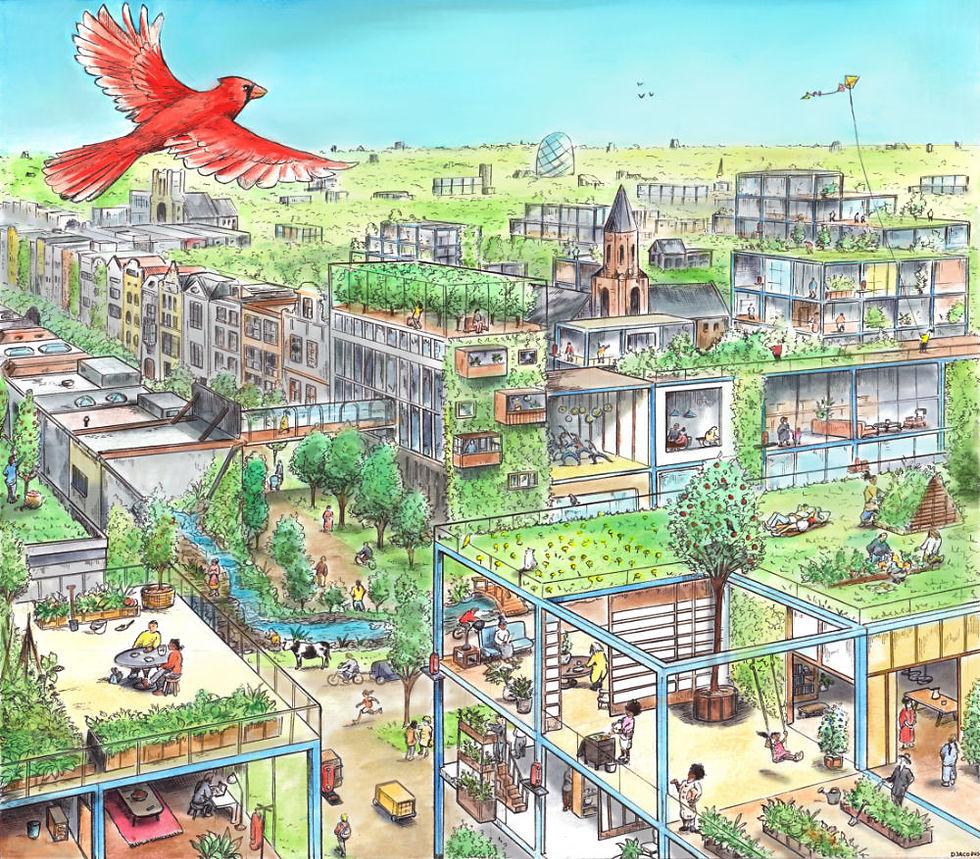
A Solarpunk city probably wouldn’t be defined by one dramatic green skyscraper.
It would be shaped by thousands of much less glamorous systems working together.
Safe walking and biking.
Pollinators and wildlife are prioritized
Reliable public transportation.
Shade.
Trees.
Clean energy.
Affordable housing.
Water-sensitive design.
Community growing spaces.
Habitat corridors.
Public gathering spaces.
Local food access.
Buildings adapted to the local climate.
Places where people can exist without being expected to spend money.
Solarpunk architecture might include passive cooling, natural ventilation, natural light, reclaimed materials, rooftop gardens, rainwater systems, adaptable buildings, and energy-efficient design.
And a Solarpunk home doesn’t need to look futuristic.It might simply be a home that uses resources thoughtfully, responds to its climate, supports the people living inside it, and belongs to its ecosystem rather than sitting apart from it.
Solarpunk food systems, gardens, and biodiversity

Food is one of the easiest places to see Solarpunk principles becoming tangible. Most of us living in cities are fairly separated from the ecological systems that feed us. We walk into a grocery store and food is simply…there. Urban agriculture helps reconnect some of those pieces.
A more Solarpunk food system might include community gardens, urban farms, rooftop growing, hydroponics, food forests, regenerative agriculture, edible landscapes, farmers markets, seed sharing, composting, controlled-environment agriculture, and stronger relationships between local growers and communities.
But growing food isn’t the only goal. A garden can become much more than a place where tomatoes come from. Flowers provide nectar and pollen, mulch protects soil, healthy soil supports fungi, microorganisms, insects, and plant roots, native plants provide habitat, trees create shade, and plant diversity gives wildlife more opportunities to feed, shelter, and reproduce.
Suddenly, the garden becomes a small ecosystem.
And that’s something I’ve become increasingly interested in through my own work. At The Eco Connection, I’ve documented urban growing spaces where food production, biodiversity, soil health, pollinator habitat, vertical growing, and observation all overlap.
The more you pay attention, the harder it becomes to think of these things as completely separate topics. Urban agriculture is also ecology.
Solarpunk fashion and conscious consumption
And no, practicing Solarpunk doesn’t mean you need to go buy an entirely new wardrobe filled with linen, botanical prints, and utility vests. That would be a little beside the point. The more meaningful connection is our relationship with clothing itself: repairing, rewearing, tailoring, swapping, buying secondhand, choosing durable pieces, taking care of what we already own, learning basic mending, supporting local makers when it makes sense, respecting the cultural origins of design, and resisting the idea that every new identity requires another shopping haul.
Conscious consumption means that we are intentional and thoughtful aboutwhat we buy and use, why we want it, how it was made, and what happens to it afterward.
The same principle applies far beyond fashion. A Solarpunk approach to consumption asks us to move away from “What sustainable thing should I buy?” and toward “Do I need to buy something at all?” Sometimes the most sustainable purchase is the one we never make.
Seven ways to start living more Solarpunk
You don’t need land, specialized technology, or a huge budget. Start where you are.
Plant Something for Pollinators: Bees, butterflies, and birds need our help. Try native wildflowers or herbs like lavender, thyme, or mint.
Repair or Upcycle Something You Already Own: Mend your clothes, repaint old furniture, or get creative with what you have.
Spend a Day Without Disposable Plastic: Notice what you reach for and swap in a reusable option where you can.
Sketch, Journal, or Pin Your Vision of a Solarpunk World: Don’t just dream it. Draw it, pin it, and read about it.
Take a Nature Walk: Observe and document the nature around you, even in small or urban spaces.
Swap or Gift Something: Share books, plants, clothes, or seeds with a friend or neighbor.
Make a DIY Natural Cleaner or Body Product: Start with simple ingredients like argan oil, jojoba oil (natural skin and hair care), or even household products like olive oil and vinegar.
Solarpunk in practice at The Eco Connection
This is where Solarpunk becomes especially meaningful to me. At The Eco Connection, it gives us a way to connect topics that are often treated as completely separate: urban gardening, biodiversity, urban agriculture, food systems, regenerative practices, waste reduction, technology, community resilience, and hopeful visions of the future.
Our Dr. Phillips urban garden project is one place where those connections became visible. Over the course of the project, I documented things like soil coverage, plant vitality, pollinator activity, pest balance, harvests, companion planting, compost, leaf mulch, trellising, and habitat diversity. It wasn’t a controlled scientific study, and I don’t present it as one. It was something I think can be equally valuable: transparent, place-based learning. We observed what changed, documented what worked, noticed what didn’t, and adapted.
I’ve seen the same principle at a much smaller scale in my own container garden in Orlando. A few pots obviously aren’t going to transform a city’s food system, but they have changed the way I notice the ecosystem around me. You start paying attention to which insects arrive, where the afternoon heat settles, which plants thrive, which ones struggle, how quickly soil dries out, what organic material can be returned to the system, and how much life can occupy a surprisingly small space.
That’s one reason I’m skeptical of the idea that Solarpunk has to look enormous or futuristic. Sometimes it looks pretty ordinary: a pot of herbs, a handful of seeds, a reused container, a bee visiting a flower, or a neighbor sharing something they grew. And maybe that’s the whole point.
Solarpunk living isn’t about getting it right. It’s about imagining better and beginning anyway
FAQs
Is Solarpunk utopian or dystopian?
Solarpunk is generally optimistic rather than dystopian, but that doesn’t mean it imagines a flawless world.
Strong Solarpunk stories and projects can still include climate damage, scarcity, conflict, injustice, and difficult tradeoffs.
What makes them different is the presence of agency.
People are still capable of adapting, organizing, repairing, rebuilding, and changing systems.
Is Solarpunk political?
Solarpunk is not one political party or official ideology.
Many writers and communities associated with it critique extractive capitalism, inequality, colonialism, corporate power, and systems that remove people from ecological decision-making.
Others approach Solarpunk through fiction, architecture, urban planning, agriculture, design, community resilience, or practical sustainability.
The common thread is a willingness to question systems that cause harm and imagine fairer, more ecological alternatives.
What is the Solarpunk aesthetic?
The Solarpunk aesthetic often combines plants, sunlight, renewable energy, visible repair, local craft, colorful design, and Art Nouveau-inspired forms.
But its deeper purpose is to make regenerative futures visible.
A green-looking image without ecological function, access, or community is ultimately just decoration.
How is Solarpunk different from sustainability?
Sustainability often focuses on reducing harm or maintaining systems over time.
Solarpunk adds another layer:
imagination.
Culture.
Beauty.
Community participation.
Justice.
Transformation.
Instead of asking only:
How can we make the current system less harmful?
Solarpunk also asks:
What should we build instead?
Can I practice Solarpunk in an apartment?
Absolutely.
Grow herbs or pollinator plants in containers.
Try microgreens.
Repair household items.
Use libraries and shared resources.
Reduce waste.
Participate in community composting.
Learn about your neighborhood ecology.
Support local projects.
Solarpunk is much more about relationships and systems than the size of your yard.
Is Solarpunk only art or science fiction?
No. Art and fiction are important because they help people imagine alternatives.
But Solarpunk also shows up through gardening, architecture, renewable energy, repair, urban planning, food systems, mutual aid, education, community organizing, ecological restoration, and local resilience.
The vision and the practice strengthen each other.
Sources & Further Reading
Adam Flynn, Solarpunk: Notes toward a Manifesto
University of Copenhagen Environmental Humanities Glossary, Solarpunk
A Solarpunk Manifesto
Solarpunk: Refuturing Our Imagination for an Ecological Transformation, One Earth


Comments